Panel 03
Scaling laws, FLOPs and the data-loading wall
The strongest version of the convergence thesis says quantum processors will lift the compute ceiling that scaling laws have made so expensive to climb. It is worth taking seriously, and it is worth checking against what a training run actually consists of.
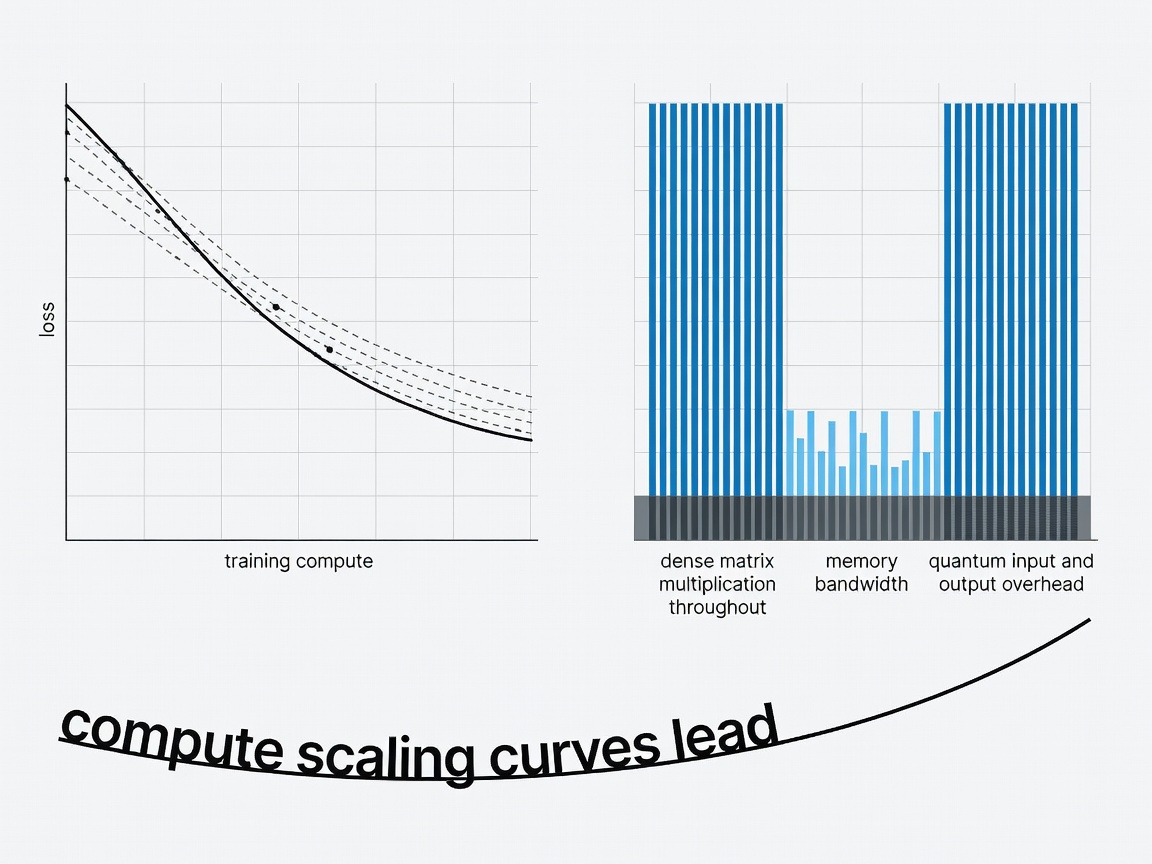
Where frontier training compute actually goes
Almost all of it goes into dense general matrix multiplications in the forward and backward passes of transformer blocks, plus attention, plus optimiser state updates. The arithmetic is low-precision and massively parallel, and the practical ceiling is as often memory bandwidth and interconnect as raw floating-point throughput — which is why high-bandwidth memory, collective communication and pipeline scheduling absorb so much engineering attention. Any proposed accelerator has to attack that specific profile, not a stylised linear-algebra problem.
Scaling laws say data and parameters, not qubits
Kaplan and colleagues established smooth power-law relations between loss, parameters, data and compute; Hoffmann and colleagues at DeepMind revised the compute-optimal allocation towards substantially more training tokens per parameter than earlier practice assumed. Both results describe a classical resource trade-off. Neither contains a term that a quantum register alters. If the binding constraints on capability are token budget, data quality and dollars per exaflop-day, then a quantum processor is answering a question nobody in that pipeline is asking.
The input problem
To do linear algebra on a quantum register you must get the data in. Amplitude encoding writes a vector of length N into the amplitudes of about log N qubits, which sounds free until you count the circuit that prepares the state — generically linear in N, which erases exponential gains. Quantum random access memory is the standard escape hatch, and it remains largely architectural: a bucket-brigade QRAM needs a number of components on the order of the dataset size, each maintained coherently, with its own error-correction burden. A training corpus is not a candidate for this in any near or middle term. Problems whose input is generated by a compact circuit, rather than loaded from disk, are the ones that dodge the wall.
Output is also expensive
The other end is worse-behaved than the pitch decks suggest. A quantum algorithm ends holding a state; obtaining the classical vector inside it means tomography, whose cost grows with the dimension you want to resolve. Expectation values are cheaper but need repeated preparation and measurement, and the shot count enters the wall-clock time directly. Gradient descent needs the whole update vector, every step. That single fact rules out most naive proposals for quantum-accelerated backpropagation.
Grover on inference is a quadratic mirage
Suppose you cast a decoding or retrieval step as unstructured search and apply amplitude amplification. The asymptotic saving is a square root. Now price the oracle: it must be a coherent, fault-tolerant circuit evaluating your objective, compiled through a discrete gate set with magic states for every non-Clifford operation. Published resource estimates for Grover-style applications consistently show the crossover point sitting far beyond problem sizes where a classical accelerator is comfortable, because the classical machine is running at nanosecond-scale throughput while a logical quantum operation costs many correction cycles. Quadratic does not beat six orders of magnitude in constants at practical sizes.
Energy, Landauer and the cryostat
Energy is the one axis where the quantum argument has genuine theoretical appeal. Landauer's principle sets a lower bound on the energy dissipated by an irreversible bit erasure, proportional to temperature, and quantum circuits are unitary and therefore logically reversible. That is a real asymptotic advantage in principle. In practice, dilution refrigerators, laser systems and room-temperature control racks put a large fixed power draw behind every logical operation, and error correction multiplies the physical operations per logical one. The interesting question is not the bound but the crossing point, and nobody can state it without assuming a hardware generation that does not yet exist.
Where the arrow points the other way
Meanwhile the traffic in the opposite direction is heavy and unglamorous. Learned syndrome decoders, reinforcement learning for pulse and circuit compilation, Bayesian and neural methods for automated device tuning, generative models for calibration drift, neural quantum states for classical simulation of quantum systems. Machine learning is already load-bearing infrastructure inside quantum laboratories. If you want to see the convergence working today, look there rather than at a quantum-accelerated language model.
Falsifiable expectations
- A quantum subroutine that provides a full classical parameter update for a large dense model at lower total cost than a classical accelerator. Not demonstrated, and the readout argument says why.
- A quantum-generated dataset — simulated chemistry or materials data — that measurably improves a classical model trained on it. Plausible, testable, and the chemistry route is the most promising.
- A learned component inside the quantum control stack that beats the best classical algorithm at the same latency budget. Already happening for decoding.
- An end-to-end runtime advantage for an industrially relevant optimisation problem against a well-tuned classical solver. Repeatedly claimed, repeatedly narrowed on closer benchmarking.
Primary reading: Kaplan and colleagues on neural scaling laws (arXiv:2001.08361); Hoffmann and colleagues on compute-optimal training (arXiv:2203.15556); Preskill on near-term expectations (arXiv:1801.00862). Landauer's bound is in his 1961 IBM Journal of Research and Development paper.