Panel 02
Modalities, fidelities and the error-correction tax
Algorithmic promises are settled by hardware constraints, and the constraints differ so sharply between modalities that "number of qubits" is close to a useless comparator. What matters is the joint envelope: two-qubit fidelity, coherence relative to gate time, native connectivity, measurement latency, and how much of the machine has to be replicated to buy one logical qubit.
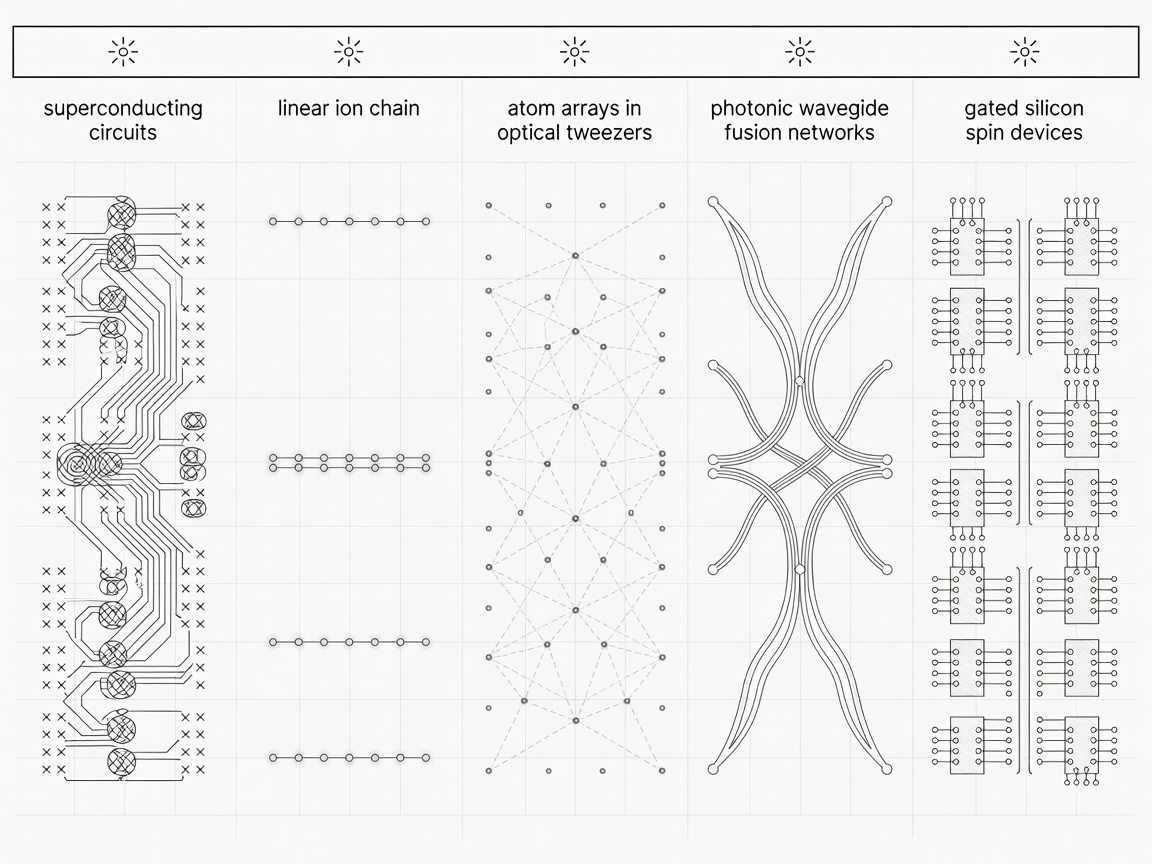
Superconducting circuits
Transmons on planar chips, driven by microwave pulses and read out through dispersive resonators, are the substrate behind the programmes at IBM, Google, Rigetti and IQM, and behind the bosonic variants pursued by groups working on cat and GKP encodings, including Alice & Bob and the Yale-derived line of research. Gate times are short, which is the main attraction. The costs are fixed coupling graphs that force SWAP overhead, fabrication variation across a wafer, and a wiring and cryogenic budget that grows with every physical qubit. Dilution refrigerators have finite cooling power and finite cable feedthroughs; that, not lithography, is the honest medium-term scaling wall, and it is why cryogenic control electronics and modular chip-to-chip links are such active subjects.
Trapped ions
Quantinuum's and IonQ's machines encode qubits in atomic hyperfine or optical levels and manipulate them with lasers or microwaves in electromagnetic traps. Ions are identical by construction — no fabrication spread — and shuttling in quantum charge-coupled device architectures gives effectively all-to-all connectivity, which removes a large part of the compilation overhead a fixed lattice imposes. Two-qubit fidelities in this modality have consistently been at the top of the published field. Gate times are orders of magnitude slower than superconducting gates, so throughput, not fidelity, is the limiting figure, and long chains bring motional-mode crowding.
Neutral atoms
QuEra and Pasqal build arrays of atoms held in optical tweezers, entangled through the Rydberg blockade, with reconfigurable geometry because the tweezers can be moved between rounds. That reconfigurability is genuinely useful for error correction: it allows transversal operations between code blocks that a fixed planar lattice cannot express. The open problems are atom loss and reloading, measurement that does not destroy neighbours, and laser stability across a large array.
Photonics
PsiQuantum, Xanadu and Quandela pursue measurement-based and fusion-based schemes, where entanglement is generated by interfering photons and consumed by measurement. Photons do not decohere in flight and the components are manufacturable in silicon photonics foundries, which is the strategic argument. Against that: probabilistic gates, demanding requirements on single-photon sources and detectors, and the awkward fact that high-efficiency detectors still want cryogenics, so the "room temperature" framing is partial.
Silicon spins and the topological bet
Spin qubits in silicon and germanium quantum dots, pursued at Intel and in academic groups including those at Delft and UNSW, borrow the most mature fabrication base in existence and occupy a footprint far smaller than a transmon. Their difficulties are charge noise, valley splitting and the sheer precision of gate-voltage tuning, which is where automated calibration earns its keep. Microsoft's topological programme aims at qubits protected by non-local encoding rather than by active correction; its publication record includes a retracted Majorana paper and subsequent claims that remain debated in the literature, so treat it as a high-variance research bet and read the disputes alongside the announcements.
The error-correction tax
Fault tolerance is the whole game, and the surface code — analysed in detail by Fowler and colleagues — is the default because it needs only nearest-neighbour coupling on a 2D grid. Below a code-dependent noise threshold, published in the literature at roughly the sub-percent scale depending on the noise model, adding physical qubits suppresses logical error exponentially in the code distance; above it, adding qubits makes things worse. Google Quantum AI's below-threshold surface code demonstration, published in Nature, was significant precisely because it showed the scaling with distance moving the right way. The Eastin–Knill theorem then bites: no code with transversal universal gates, so non-Clifford operations arrive via magic-state distillation or cultivation, and that factory dominates the resource estimate for any real algorithm. Low-density parity-check codes with better encoding rates are the main line of attack on that overhead, at the price of long-range connectivity a planar chip cannot provide.
Decoding is a classical machine learning problem
Every correction cycle emits a syndrome stream that must be decoded faster than it arrives or the backlog grows without bound. Minimum-weight perfect matching and union-find decoders are the classical workhorses; learned decoders — the Google DeepMind and Google Quantum AI collaboration published in Nature as AlphaQubit is the prominent example — reached competitive accuracy by modelling correlated and leakage-driven noise that matching decoders idealise away. This is the cleanest live instance of the convergence in this forum's title, and it runs in the direction people talk about least: machine learning as infrastructure for quantum computing.
Reading a roadmap without being sold one
- Ask for two-qubit error rates with the benchmarking protocol named, not a headline qubit count.
- Ask whether quoted fidelities were measured in isolation or in a full-lattice, simultaneous-operation setting.
- Ask what the connectivity graph is and what the compiler's SWAP overhead does to a realistic circuit.
- Ask where the magic states come from and what fraction of the device the factory occupies.
- Ask whether decoding is real-time on hardware or replayed offline after the run.
Primary reading: Fowler, Mariantoni, Martinis and Cleland on surface codes for practical large-scale computation; Preskill on the near-term regime (arXiv:1801.00862); the Google Quantum AI below-threshold error-correction paper in Nature; and the AlphaQubit decoder paper in Nature. DiVincenzo's criteria remain the cleanest checklist for judging any new modality.