Convergence desk

AGI and quantum computing: what happens when two transformative technologies converge?

This is a forum about two research programmes that are usually discussed in the same breath and rarely in the same terms: machine learning systems aimed at artificial general intelligence, and quantum computers built from superconducting circuits, trapped ions, neutral atoms, photons and silicon spins. We work through where the two genuinely touch, where the overlap is a marketing artefact, and which of the claims are falsifiable.

No primer here on what a qubit is. The five panels below take the convergence apart along the seams that matter — algorithmic complexity, hardware and error correction, compute economics, cryptography, and the live research agenda — and each one names the papers and the standards it argues with.

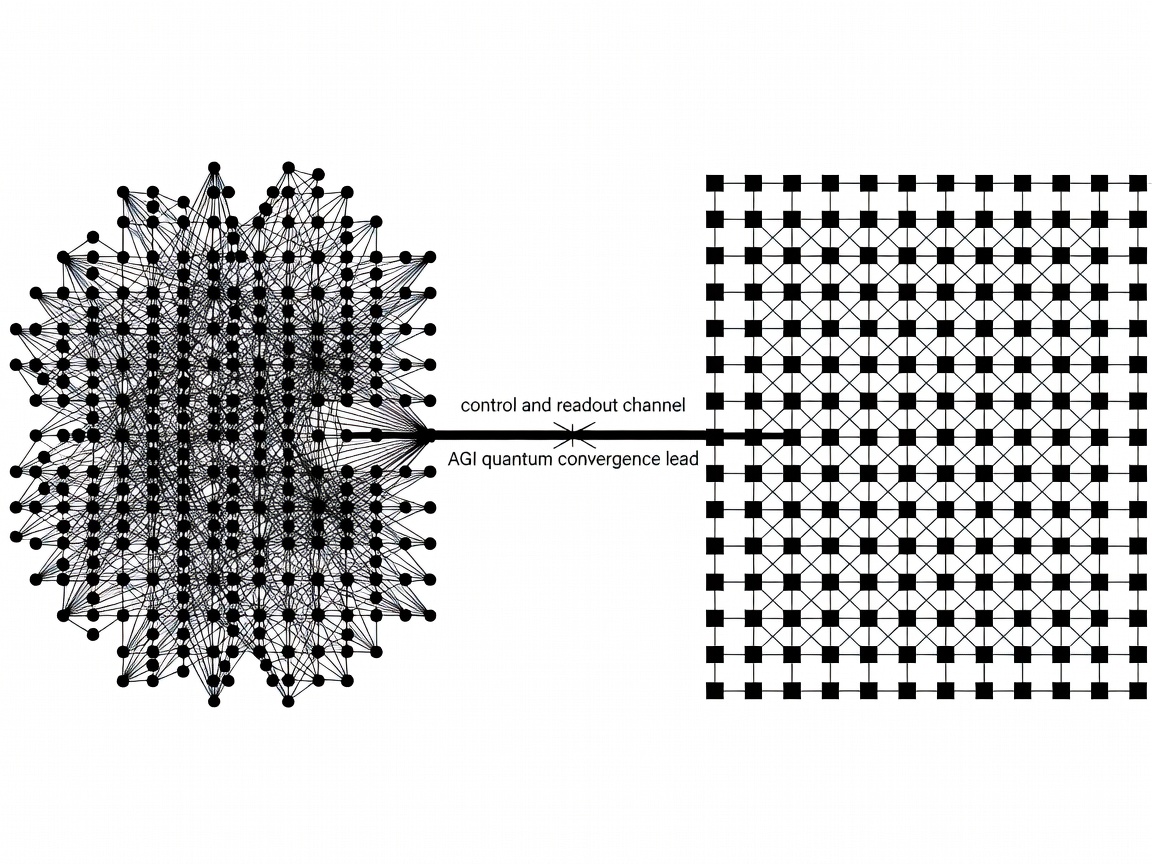
Monochrome schematic pairing a dense neural network graph on the left with a square lattice of qubits and stabiliser plaquettes on the right, joined by a control and readout channel

Five panels

Quantum algorithms that actually touch learning

Shor, Grover, HHL, dequantisation

Period finding versus amplitude amplification; the fine print on Harrow–Hassidim–Lloyd that Scott Aaronson set out in Nature Physics; Ewin Tang's quantum-inspired classical algorithm for recommendation systems and the dequantisation results that followed; barren plateaus in variational circuits after McClean and colleagues; the provable kernel speedup of Liu, Arunachalam and Temme; and Huang and colleagues on learning from experiments.

Open panel 01

Modalities, fidelities and the error-correction tax

Superconducting, ion, atom, photon, spin

What separates the transmon stacks at IBM and Google from trapped ions at Quantinuum and IonQ, neutral atoms at QuEra and Pasqal, photonics at PsiQuantum and Xanadu, and silicon spins at Intel. Surface codes after Fowler and colleagues, the Eastin–Knill constraint, magic-state distillation, and why real-time decoding turned into a machine learning problem.

Open panel 02

Scaling laws, FLOPs and the data-loading wall

Kaplan, Chinchilla, QRAM, Landauer

Frontier training is dense matrix multiplication over enormous token budgets, shaped by the scaling relations of Kaplan and colleagues and the compute-optimal revision from Hoffmann and colleagues at DeepMind. This panel asks what a fault-tolerant machine could plausibly contribute to that workload, why amplitude encoding and tomography eat the speedup, and why the arrow of usefulness currently points the other way.

Open panel 03

Shor, ML-KEM and long-lived model secrets

FIPS 203, 204, 205 and migration

The one place quantum computing breaks something outright. Shor's algorithm against RSA and elliptic-curve discrete logs, the NIST standards for module-lattice key establishment and signatures, hash-based signing, harvest-now-decrypt-later, the resource estimates of Gidney and Ekerå, and what any of it means for model weights and training corpora that are meant to stay confidential for decades.

Open panel 04

Where the two fields genuinely meet

Chemistry, decoders, control, benchmarks

Quantum simulation of nitrogenase cofactor chemistry after Reiher and colleagues; neural decoders in the Google Quantum AI line of work; reinforcement learning on pulse and circuit compilation; neural quantum states after Carleo and Troyer; tensor-network refutations of sampling-based advantage claims; and the funding structures behind all of it, from the US National Quantum Initiative to the UK's National Quantum Computing Centre.

Open panel 05
How we read a convergence claim

Most cross-field claims collapse under three questions, and we apply them on every panel. First: what is the resource being economised — gate count, sample complexity, energy, or wall-clock time on a specific machine? Second: what is the best known classical algorithm for the same task, and has anybody tried to dequantise the quantum one? Third: how does the data get in and the answer out, and is that cost inside or outside the quoted asymptotics? The third question is where most quantum machine learning proposals have historically lost their advantage.

We also separate two directions of influence that get flattened into a single narrative. Quantum hardware helping AI is a speculative claim with narrow, partly proven exceptions. AI helping quantum hardware is already ordinary engineering practice, in decoding, calibration, pulse shaping, tomography and variational parameter search. Both belong in the same conversation, but they carry different burdens of proof.

Resource asked for
The quantity a claimed speedup reduces. Gate depth, qubit count, samples, energy and classical pre- or post-processing are not interchangeable, and a paper that improves one often worsens another.
Input access model
How classical data reaches the register — amplitude encoding, quantum random access memory, or an oracle assumed into existence. Stated access models are where asymptotic advantages usually hide their costs.
Readout cost
What it takes to extract a useful classical answer from the final state. Full state tomography scales badly; expectation values need repeated shots, and the shot budget is part of the runtime.
Logical overhead
The ratio of physical qubits and operations to fault-tolerant logical ones under a chosen code and noise model. Published estimates vary by orders of magnitude with assumptions, so the assumptions are the claim.