Panel 01
Quantum algorithms that actually touch learning
Every serious convergence argument bottoms out in complexity theory, so start there. The question is not whether a quantum computer can run a neural network — it is which primitive inside a learning pipeline has a quantum algorithm with a proven separation, under an access model somebody can build.
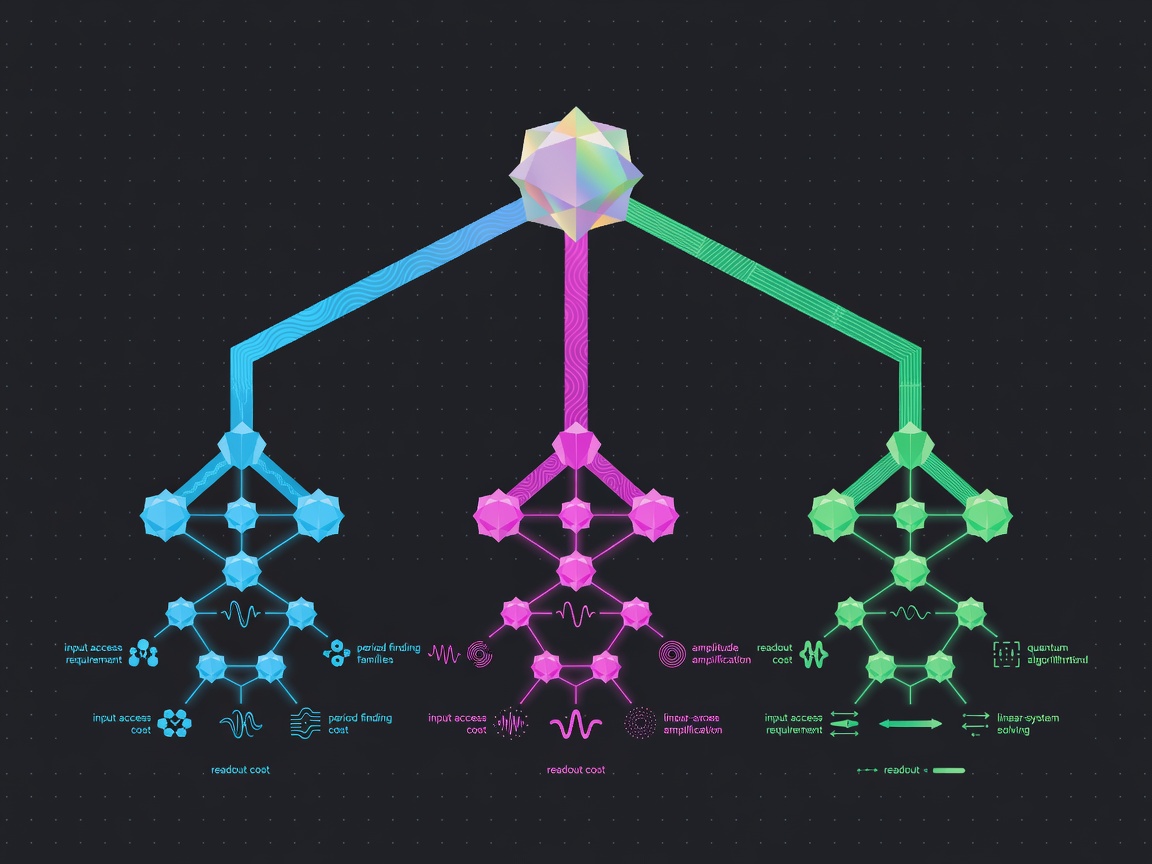
Two speedup families, and only one of them is dramatic
The Fourier-sampling family — Shor's factoring and discrete-log algorithms, and the hidden subgroup problem behind them — gives superpolynomial separations on tightly structured problems. Nothing in supervised learning has that structure. The amplitude-amplification family, headed by Grover search, is generic but quadratic, and a quadratic gain has to survive the constant factors of error-corrected gate synthesis before it means anything. Every honest resource estimate for Grover-type speedups shows the crossover pushed far out by those constants, which is why the interesting proposals cluster around a third family: simulating quantum systems, where the machine does what it is natively built to do.
HHL and the fine print
Harrow, Hassidim and Lloyd's quantum linear-systems algorithm is the load-bearing citation in most quantum machine learning pitches, and its caveats have been public since Aaronson's Read the fine print commentary in Nature Physics. The algorithm needs the matrix sparse and well conditioned, needs the right-hand side loaded into amplitudes efficiently, and returns a quantum state whose entries you cannot read out wholesale. Four conditions, any one of which can swallow the exponential. Regression on a dense design matrix satisfies none of them comfortably, and the runtime dependence on the condition number is not a footnote — it is the whole margin.
Dequantisation keeps eating the soft claims
The sharpest correction came from Ewin Tang's quantum-inspired classical algorithm for recommendation systems, which removed an exponential separation by giving the classical algorithm the same sample-and-query access the quantum one had assumed. A stream of dequantisation results followed for low-rank linear algebra, principal component analysis and related tasks. The methodological lesson for anyone reading a new paper: check whether the classical baseline was granted the same access model. If it was not, the comparison is between a quantum algorithm with a generous oracle and a classical algorithm forced to read its input from disk.
Variational circuits: expressive, trainable, rarely both
Variational quantum eigensolvers, following Peruzzo and colleagues, and the quantum approximate optimisation algorithm of Farhi, Goldstone and Gutmann put a parameterised circuit in a classical optimisation loop. It is a natural fit for shallow hardware, and it inherits a hard obstruction: McClean and colleagues showed that gradients of random deep parameterised circuits concentrate exponentially in the number of qubits, so the cost landscape flattens. Structured ansätze, local cost functions and careful initialisation mitigate it; none of them makes it go away. Add the sampling cost — expectation values need many shots per parameter update — and the classical optimiser is often the cheaper half of the loop.
Kernels with a proof behind them
Quantum kernel methods, set out by Havlíček and colleagues, replace the feature map rather than the model, estimating inner products between states prepared from classical inputs. This is the corner of quantum machine learning with a genuine rigorous result: Liu, Arunachalam and Temme constructed a classification problem, built on the discrete logarithm, with a provable quantum advantage for a kernel method. Read it for what it is — an existence proof that quantum feature maps can help on problems with cryptographic structure, not evidence that they help on images or text.
Learning from experiments, not from datasets
The most robust separations arrive when the data is itself quantum. Huang and colleagues, publishing in Science, demonstrated exponential advantages in sample complexity for learning properties of physical systems when a quantum memory can hold the experimental output coherently. Pair that with classical shadows for efficient property estimation and you have a research direction where the quantum register is the sensor, not the accelerator. It matters for materials characterisation and for calibrating the machines themselves; it does not shorten a language model training run.
What survives for AGI-scale training
Frontier model training is backpropagation over dense tensors at enormous scale, bandwidth-bound as much as arithmetic-bound. There is no quantum primitive that returns a full classical weight update faster than a classical one, and the register cannot hold parameter counts of that order in any read-writable sense. What plausibly survives: combinatorial subproblems in architecture and scheduling, sampling from structured distributions, simulation of quantum systems whose outputs feed scientific models, and — furthest out — inference on small components where a quadratic gain is worth the interconnect.
| Claim type | Regime it needs | What usually kills it |
|---|---|---|
| Exponential speedup for linear algebra | Sparse, well-conditioned operator; amplitude-encoded input; expectation-value output | Input loading and readout costs, or a dequantised classical rival with the same access |
| Quadratic search speedup in training or inference | Coherent oracle for the objective; deep fault-tolerant circuits | Constant factors of error-corrected gate synthesis and oracle construction |
| Trainable variational model at scale | Shallow structured ansatz; local cost function; modest shot budget | Gradient concentration in expressive circuits, plus shot-noise cost per update |
| Kernel advantage | Problem with algebraic or cryptographic structure | No structure in the real dataset, so classical kernels match it |
| Sample-complexity advantage | Quantum data held in quantum memory | Nothing yet, which is why this is the strongest branch |
Primary reading for this panel: Harrow, Hassidim and Lloyd on quantum linear systems (arXiv:0811.3171); Tang on dequantising recommendation systems (arXiv:1807.04271); McClean and colleagues on barren plateaus (arXiv:1803.11173); Farhi, Goldstone and Gutmann on QAOA (arXiv:1411.4028). Aaronson's fine-print commentary appeared in Nature Physics; Havlíček and colleagues on quantum feature spaces and Liu, Arunachalam and Temme on a rigorous supervised speedup appeared in Nature and Nature Physics respectively.
Next: the modalities and the error-correction tax, which decide whether any of these circuits can be run deep enough to matter.