Panel 05
Where the two fields genuinely meet
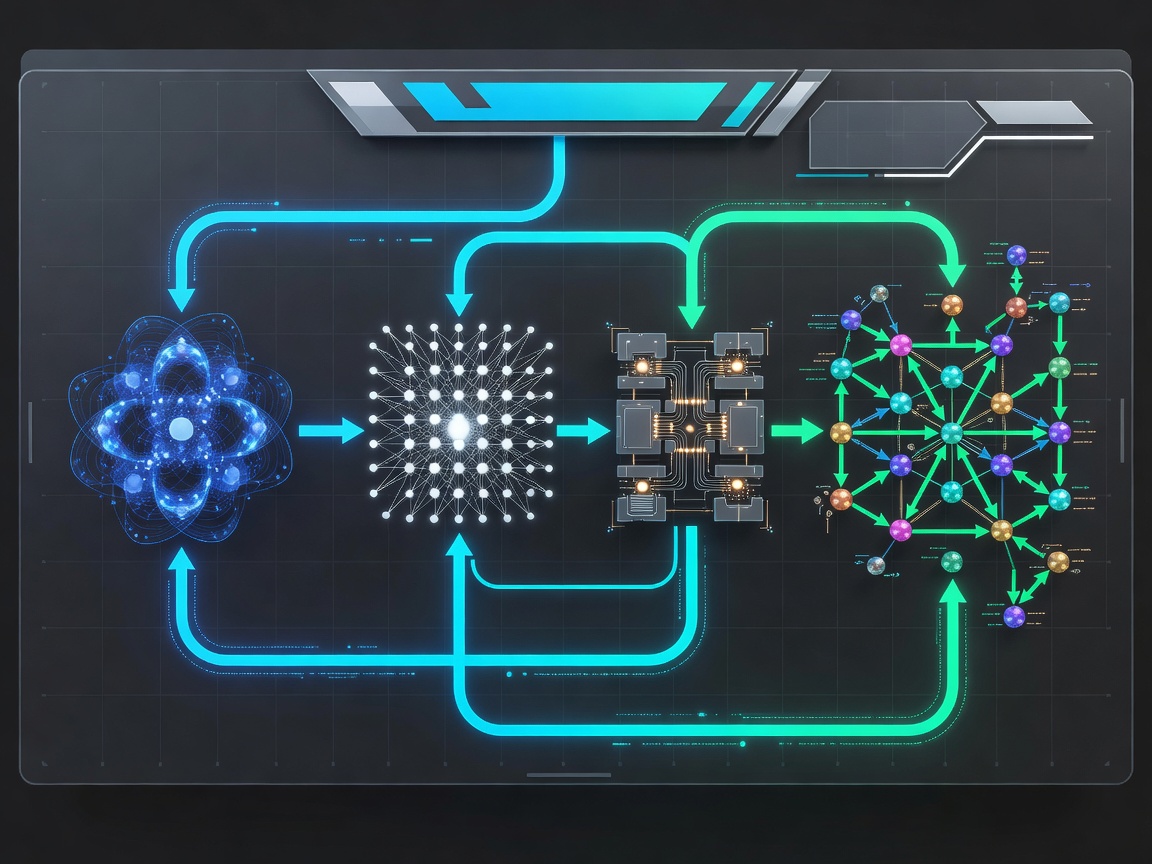
Strip out the speculation and a working research agenda remains, most of it unglamorous and most of it running in the direction the press releases neglect: classical learning systems as instruments inside quantum laboratories, and quantum simulation as a data source for classical science.
Simulating chemistry is the honest killer application
Quantum computers were proposed for simulating quantum systems, and that remains the application with the cleanest argument. The canonical target in the literature is the nitrogenase iron-molybdenum cofactor: Reiher, Wiebe, Svore, Wecker and Troyer analysed elucidating its reaction mechanism on a quantum computer and set out the resource requirements, and the paper became a reference point precisely because it was specific about cost. Strongly correlated transition-metal active sites are hard for coupled cluster and awkward for density functional theory, and getting them right matters for catalysis, nitrogen fixation and battery electrochemistry. That is also where the AI connection is real: better simulated data improves the interatomic potentials and property models that classical machine learning trains on.
Hamiltonian learning and classical shadows
Characterising a device or a material means estimating the operator that generates its dynamics from limited measurements — a statistical inference problem with quantum data. Classical shadows, introduced by Huang, Kueng and Preskill, give an efficient randomised-measurement route to many properties at once, and Hamiltonian learning protocols build on similar ideas. Huang and colleagues' Science result on quantum advantage in learning from experiments belongs in the same cluster: when the experimental output can be held in quantum memory, sample complexity separations are provable rather than heuristic. This is the part of quantum machine learning with the least hand-waving in it.
Neural decoders
Surface-code decoding is a structured-prediction problem on a stream of noisy syndrome data, with a hard latency constraint. Matching and union-find decoders are fast and assume an idealised noise model; learned decoders can absorb leakage, crosstalk and correlated errors that the idealisation drops. The Google DeepMind and Google Quantum AI decoder published in Nature as AlphaQubit is the prominent demonstration that a recurrent-transformer model can outperform matching on real device data. The open engineering question is inference within the correction cycle on cryogenic-adjacent hardware, not accuracy in offline replay.
Reinforcement learning on the control stack
Pulse shaping, gate calibration and circuit compilation are all optimisation problems with expensive, noisy objective functions — a natural fit for reinforcement learning and Bayesian optimisation. Published work covers learned pulse sequences for higher-fidelity gates, automated tuning of quantum-dot devices from charge-stability data, and routing and scheduling on constrained connectivity graphs. There is a good precedent for the compilation side in DeepMind's AlphaTensor result on matrix-multiplication algorithms: discrete algorithm search is a domain where learned search has already beaten decades-old human constructions.
Neural quantum states and tensor networks
The classical simulation frontier moves too, and this is what keeps advantage claims honest. Carleo and Troyer's variational representation of many-body wavefunctions with neural networks, published in Science, opened a line of work in which the ansatz is a learned function rather than a hand-built tensor structure. Alongside it, tensor-network methods — matrix product states, projected entangled pair states and contraction-order optimisation — have repeatedly narrowed or overturned sampling-based advantage claims. Random-circuit and boson-sampling demonstrations have each drawn credible classical counter-simulations, and treating that cycle as a normal part of the field rather than an embarrassment is the correct posture.
Benchmarks and the refutation cycle
Comparing machines is harder than comparing chips. Randomised benchmarking and cross-entropy benchmarking probe circuit-level fidelity; quantum volume, introduced by IBM, folds width and depth into a single figure; application-level suites try to measure something users care about and inherit all the usual difficulties of application benchmarks. A benchmark that a vendor designed, ran and reported is evidence about a device, not a ranking. Ask for the protocol, the calibration state, the postselection policy and whether an independent group reproduced it.
Software and who funds the work
The practical entry points are open-source: Qiskit, Cirq, PennyLane and the differentiable-programming tooling around them, plus tensor-network libraries for classical baselines. Funding structure shapes the agenda too — the US National Quantum Initiative and the Department of Energy's research centres, the European Union's Quantum Flagship, the UK's National Quantum Computing Centre and National Quantum Technologies Programme, and institutional programmes in Japan including work at RIKEN. Reading a national strategy alongside a preprint is a good habit: it explains which problems get staffed.
Open questions worth watching
- Whether quantum-generated chemistry data measurably improves classical surrogate models on tasks with independent validation.
- Whether learned decoders can run inside the correction cycle at scale, not only in offline analysis.
- Whether low-density parity-check codes with better rates can be implemented on hardware with the connectivity they need.
- Whether any variational method escapes gradient concentration without assuming away the expressivity that motivated it.
- Whether classical simulation continues to close the gap on sampling-based advantage demonstrations.
Primary reading: Reiher and colleagues on reaction mechanisms on quantum computers, in PNAS; Huang, Kueng and Preskill on classical shadows, and Huang and colleagues on learning from experiments in Science; Carleo and Troyer on neural-network quantum states in Science; the AlphaQubit decoder paper in Nature. For the near-term framing, Preskill's NISQ essay remains the reference (arXiv:1801.00862).